Air problems rarely show up as air problems.
They show up as a clammy gym the first week of August. A classroom that's 80 degrees at 8 a.m. Ceiling tiles that stain every spring and get painted over every summer. More kids in the nurse's office after lunch, and nobody connects it to the room they just left.
That's where we started on October 20 with the first session of Facility Forward, our new webinar series for the people who run the buildings. Natalie Turner, Chad Schenck, Andrew Apro, and Dave Blevins spent 30 minutes on one topic: the air in your schools, and what you can do about it this year.
Here's what we covered.
This is a normal-building problem
Chad was a superintendent before he joined us, so he's been the one answering for the building. His point was simple. A leaking roof announces itself. Air doesn't. The person who finally says something is usually a teacher, a coach, a parent, or the school nurse. By the time it reaches facilities, it's been happening for a while.
And it's more common than most people think. The average U.S. school building is 49 years old, and 38% were built before 1970 (NCES). About half of schools report indoor air quality problems (EPA). In a Berkeley Lab study of 162 classrooms, more than half fell short of the ventilation standard.
The stakes go beyond comfort. Mold can start growing on a damp surface in 24 to 48 hours, so one humid weekend with the AC set back is enough. One in ten school-age kids has asthma, and asthma accounts for more than 10.5 million missed school days a year (EPA). In most of our states, funding follows attendance.

The five drivers
Andrew walked through the framework we use with every school. Every air problem lives in one of five places.
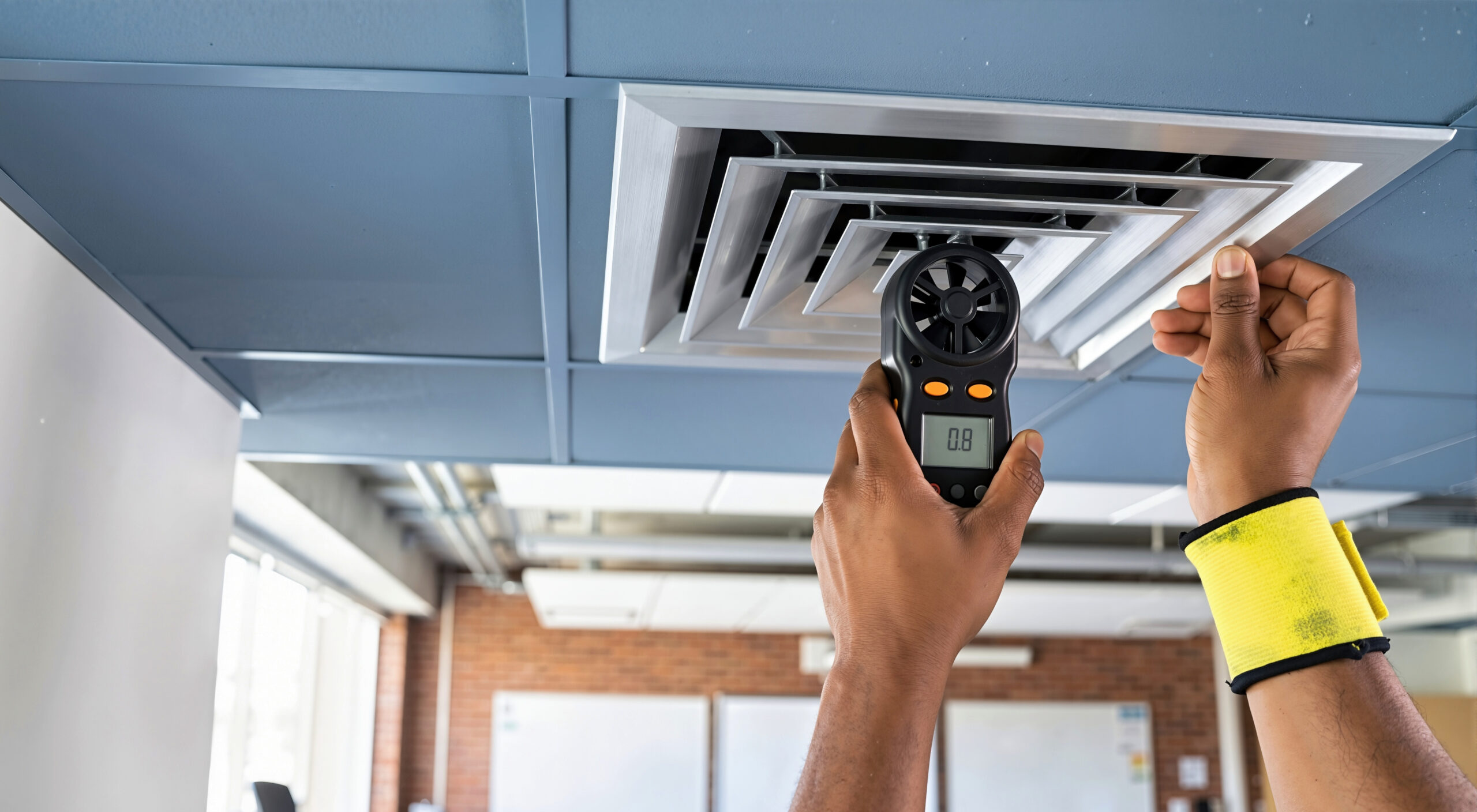
1. Ventilation. Kids get drowsy after lunch and rooms smell like the room. ASHRAE guidance calls for 3 to 6 air changes an hour while a room is occupied, and CO2 is the simplest way to check. A CO2 walk-through tells you in one afternoon which rooms are starving for air.
2. Filtration. Filters bought on price and changed on memory. MERV 13 is the recommended minimum for schools, but higher isn't automatically better. The right filter is the best one your equipment can actually push air through. A filter audit is the cheapest win there is.
3. Humidity. Condensation on walls, buckling tiles, and that August smell. Hold humidity between 40 and 60 percent year-round. This is usually a controls and equipment-sizing fix, and often one you can tackle room by room.
4. Pressurization. Doors that whistle or slam themselves, and hallways that smell like the kitchen. A building under negative pressure pulls humid, unfiltered air through every crack. Propping doors open on a humid day makes it worse. Balancing is rarely a big capital fix. It's measurement plus dampers and fans doing their jobs.
5. Monitoring. In most classrooms, the only sensor is a thermostat. That's why problems surface as complaints months later. Sensors at the air handlers and in a sample of classrooms, tracking CO2, humidity, temperature, and fine particles, turn anecdotes into data. They also prove the fix worked.
How schools pay for it
This is where most conversations stall, so Andrew broke it into three paths. Most schools use all three.
Quick installs like filter upgrades, controls fixes, and balancing can happen this school year, often over a break. Planned projects like RTU and boiler replacements or building automation work best when sequenced from a facility assessment over one to three years. And guaranteed savings programs can turn wasted energy into the budget for IAQ work. Schools spend about $8 billion a year on energy and waste roughly 30% of it (ENERGY STAR).
Five questions to ask this month
Natalie closed with one question per driver. You don't need an engineer in the room to ask them.
- When were our ventilation rates last measured, room by room?
- What filter spec are we buying, and can our units handle MERV 13?
- Where does humidity sit in our worst room in August and January?
- Which way is the building breathing when the doors open?
- If a board member or a parent asked about our air tomorrow, what would we show them?
Only 39% of schools have someone assigned to watch their air (NCES). If nobody owns it in your buildings, these questions are a good place to start.
Your next step
Missed the session, or want to share it with your team? Watch the full webinar and download the School Air Scorecard here. The Scorecard is a one-page tool that scores any building in about ten minutes.
Fill it out and we'll come do a free building walk-through to check your answers with real measurements. Then we'll show you which fixes fit this year's budget and which belong in a longer plan.
Reach out at nturner@perfectiongroup.com to schedule your walk-through.
Session two of Facility Forward is coming this winter. We'll see you there